

One Family’s Fight to Stay Whole
What “Abide in Love” Means in Rolla
Abide in Love Rolla, created in 2025, is a grass-roots group of volunteers committed to nonviolence, practical support, and radical empathy for families impacted by immigration detention. It began when a group of citizens learned that a detainee committed suicide in the Phelps County Jail in Rolla in April 2025.
One of Abide in Love’s earliest cases involved Julianne, a bookstore owner in Pacific, Missouri, whose partner Polo was detained in St. Louis. He was transferred to the Phelps County Jail, where an Abide in Love pen-pal became familiar with Polo, then reached out to Julianne to begin providing support to both.
Polo’s Story: From Provider to Prisoner
Polo, a devout Catholic, owned a home and ran a roofing business. He paid taxes and supported his six American-born children. He had legal status until one day in the first Trump administration. He went in for his officially arranged check-in, but the office was closed -- The federal government rescheduled his appointment but gave him a date prior to the first appointment! This scheduling error at the immigration office left Polo technically out of status, with no accessible pathway to correct it.
In April 2025, following the tornado in St. Louis, Polo went to help one of his clients who needed a tree removed from their living room. While working on the site, another worker began harassing Polo, escalating into physical violence. When Polo turned to walk away, the man hit Polo on the back of the head with a hammer. When the police arrived, they removed Polo from the ambulance where he was being treated for injuries (that included a concussion) and took him into custody.
Life Inside: Cruelty in Our Backyard
In St. Louis, Polo was interrogated for 17 hours in English, with no interpreter. Given his basic English skills, being a type 1 diabetic, now without medication, and a concussion, this was agonizing. He never received any medical treatment or assessment for his concussion. Then, he was transported to Phelps County Jail in Rolla, MO.
What many may not understand is that, across Missouri and beyond, county jails, corporate-owned facilities, and ICE sites on Army bases form a hidden network of detention far from public view. Rules and oversight vary from place to place. People held inside have very limited rights, and each facility does things its own way.
When immigrants are detained, everything is taken from them.
In cities with an Abide in Love chapter, the detainees receive a pen-pal who provides them with e-funds on an account so they can call their family to let them know where they are and allows them to purchase basic needs from the commissary. However, when they are moved to the next facility, all their e-funds are emptied.
Over the course of the next 8 months, Polo was moved from facility to facility. Sometimes, he was in different county jails that are paid by ICE to house detainees. County jails have a long procedure to get medications approved by ICE. In ICE facilities, he received no medication, was not allowed to test his blood sugar, and often was denied meals.
Polo was repeatedly told, “If you plead guilty and agree to a plea deal, you'll be in Mexico by Monday”. However, after agreeing to their deal, Polo was moved with no notice from one facility to another for over a month. He landed in the largest ICE immigrant detention facility in the USA -- in El Paso, TX.
In El Paso, men went hungry enough to eat toothpaste. They slept sitting up in overcrowded cages under desert heat that often topped 100 degrees. Guards sometimes encouraged fights and even placed bets on them. Polo spent time in solitary after helping an elderly man who fainted. He was denied communion, a core part of his faith. Polo has not even told Julianne all that he went through in order to protect her.
Returning Men to Fragile Communities
The time spent in El Paso, especially without medication, seemed interminable. Abide in Love trategically called and emailed on Polo's behalf, making sure Julianne didn't have to do this alone and that the facility knew he had a community behind him, paying attention to his treatment. The facility chose to deport Polo.
Polo was deported alongside twenty other detainees that day. Before releasing them, American agents told them they destroyed their identification and left them on the streets of Ciudad Juárez—one of the most dangerous cities in the world. Julianne managed to send him $500, so he was not entirely without resources.
The Cost to Families Left Behind
Julianne’s love carried a cost. Before, she owned a home, a business, lived near her best friend, her community, and had air conditioning. They sold assets of their businesses, their home, their retirement funds, and more to come up with $89,000 in legal fees. Julianne lives with the threat that their brown, bilingual kids could be targeted by ICE because of changing citizenship. Or that her children will be targeted by people full of hate.
Now, Julianne, who doesn’t speak much Spanish, has uprooted her life and moved with her youngest children to Mexico. They were living in Polo’s original home area, where cartels controlled everything. No relationship with the cartel means you do not work. So, they had only sandwiches and ramen for meals. Just recently, they have been able to move to another state where there is more opportunity to work. Polo has not found steady work, but he has found some work.
Notes from Julianne following this experience
Julianne noted that all of these detainees have PTSD. Mexico does not have any mental health infrastructure to deal with this issue. Consider what we are releasing out into the world.
Julianne noted “As an adult I got out of the church…This experience, and Polo's experience—he's Catholic, obviously—changed me. He'd ask me, can you just go to Mass with the babies on Sunday and light a candle for me? Seeing his steadfastness changed me. I see the active miracles now.”
“I'll never forget the look on his face in the video call when he was in Juarez and got to see the sky for the first time in eight months.”
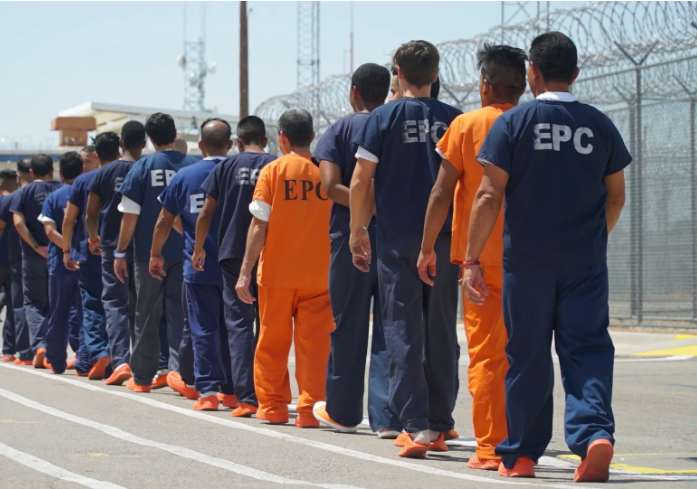
About two dozen detainees were escorted across a courtyard by contract security guards. Blue uniforms indicate those with no criminal history. Orange uniforms are for inmates previously arrested. Photo: Jesse Seidman/Vice News
